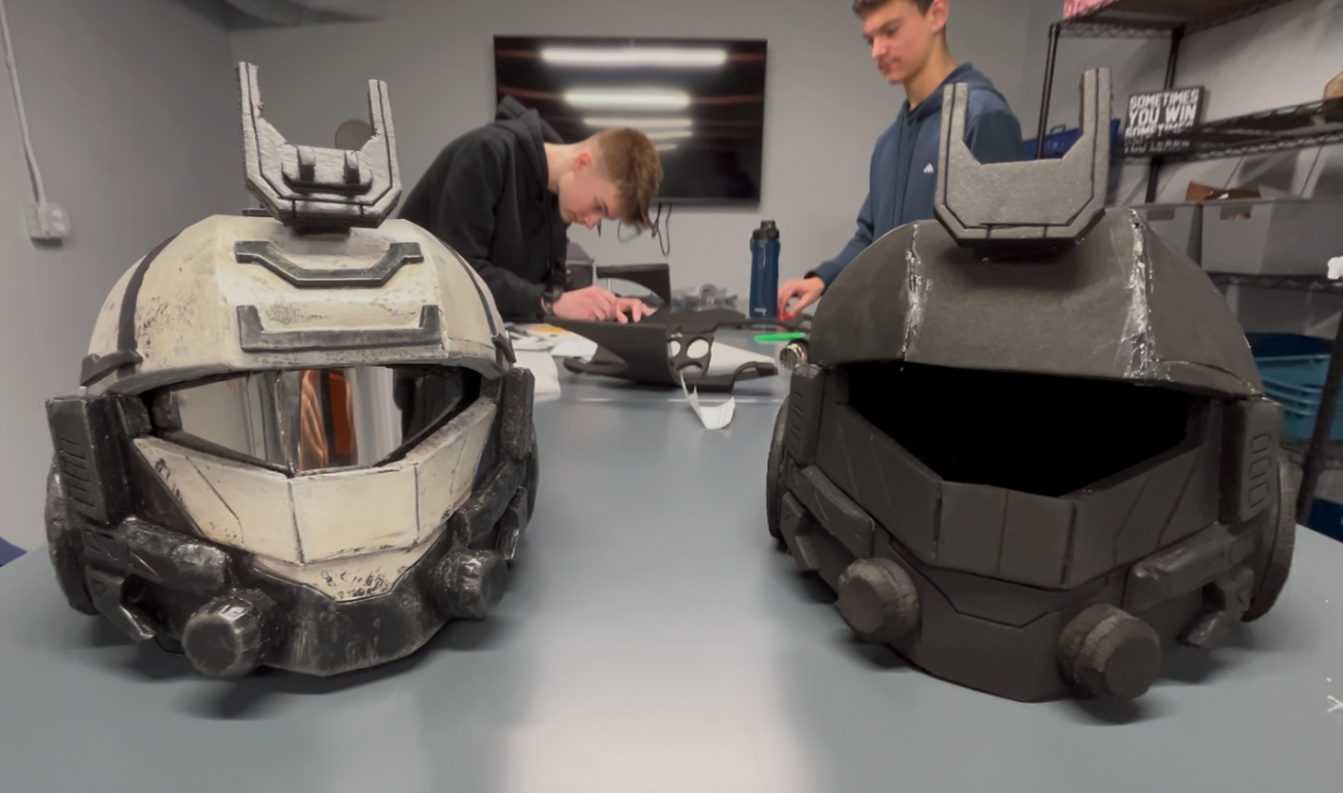
Prop Forge, a one semester course offered in the spring, introduces students to the technical and creative world of prop making. The curriculum moves from basic material manipulation to complex assembly, covering essential "durable skills" such as spatial reasoning, measurement, and persistence through failure. Students will explore the physics of durability and the aesthetics of "weathering" to make new materials look ancient or battle-worn. As they master our MADE TO MAKE mindset, students develop a powerful toolkit of skills turning their most imaginative concepts into tangible, wearable reality.
Master Material Transformation: Use heat-forming and cutting techniques to turn flat foam and cardboard into 3D structures.
Apply Technical Measurement: Execute precise "sizing for fit" to ensure armor and helmets are ergonomic and wearable.
Implement Advanced Finishing: Use multi-stage painting and "weathering" techniques to simulate metal, wood, or leather.
Integrate Basic Electronics: Build simple parallel circuits to add LED lighting effects to props.
Navigate the Iterative Process: Test props for durability, analyze structural failures, and redesign for better performance.
Course activities and learning objectives will include:
The Foundations of "Greebling": Introduction to upcycling; identifying shapes in junk; safety with cutting tools and adhesives.
Cardboard Engineering & Geometry: Building structural integrity; creating compound curves with flat sheets; scale and proportion.
Foam Smithing & Heat Shaping: Introduction to EVA foam; using heat guns to "form" armor; beveling edges and hiding seams.
Ergonomics & Sizing for Fit: Taking body measurements; creating paper templates (patterning) for wearable helmets and bracers.
Intro to "Prop-tronics": Basic circuitry; soldering safety; hiding battery packs and LEDs within a prop.
Durability Testing & Stress Points: Stress-testing joints; identifying points of failure; iterating designs for "battle-readiness."
The Art of the Finish: Priming surfaces; metallic paint layering; "black-washing" and rust effects for realism.
Capstone (The Signature Piece): Planning and assembling a complex, multi-part prop or armor set.
The Forge Showcase: Final presentation; "Runway" fit test; reflection on the journey from failure to finished product.
Students will be provided with tools, training and basic building supplies, but will also be responsible for sourcing their own raw making materials based on the build they choose. For example, students may want to purchase foam mats (gym mats) to build their helmet. This would be an additional class expense. We always focus on recycled material like cardboard which is a great way to build.
Competency Outcomes
Prop Forge utilizes a Competency-Based Assessment model, providing a 360-degree view of student growth in the following areas:
Manual Dexterity: Precision in cutting, carving, and assembling complex parts.
Mathematical Accuracy: Correct use of measurement and scale for wearable components.
Iterative Resilience: The ability to document a "failed" build and apply those lessons to version 2.0.
Aesthetic Quality: Skill in painting, texturing, and lighting to create a cohesive look.
Presentation: showcase a durable, wearable, and illuminated prop that meets original design specifications.